Editor’s Note: This article was first published at Common Dreams.
SALT LAKE CITY, UT — In an effort to fulfill President Donald Trump’s executive order on homelessness, Utah is building a massive facility that housing advocates warn will function as an “internment camp” where the unhoused will be subject to forced labor.
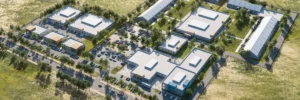
Last month, Utah’s homeless services agencies came to an agreement for the state to acquire a nearly 16-acre parcel of rural land in the Northpoint area of northwest Salt Lake City to construct the first-of-its-kind facility, which is slated to have 1,300 beds.
The genesis of the project began in July, following Trump’s “Ending Crime and Disorder on America’s Streets” executive order, which threatened to withhold funding from states and cities unless they criminalized homeless people camping on streets and ordered the attorney general to expand the use of involuntary civil commitment for adults experiencing homelessness.
Despite a large body of evidence showing their effectiveness at curbing crime while keeping people off the street, the order also required the Department of Housing and Urban Development (HUD) to end its support of “Housing First” policies that provide unhoused people with homes without the requirement of behavioral health treatment or sobriety.
Less than a week after Trump’s homelessness order, Utah’s Republican Gov. Spencer Cox, as well as the state Senate president and House speaker—both Republicans—sent a letter to the state’s Homeless Services Board, which was created last year following a legislative push by the Cicero Institute—a far-right think tank that has proposed aggressive measures to criminalize homelessness and which has had major influence over Trump’s crackdown on the homeless during his second term.
In the letter, the leaders agreed with the Trump administration that they “do not support ‘Housing First’ policies that lack accountability.” They directed the Board to “accelerate progress on a transformative, services-based homeless campus that prioritizes recovery, treatment, and long-term outcomes, not just emergency shelter.”
As far back as 2023, Trump has proposed using “large parcels of inexpensive land” to set up “tent cities” or camps for homeless people, coupled with a pledge to use “every tool, lever, and authority” to clear encampments from city streets. On the podcast Invisible People, which focuses on homelessness in America, Eric Tars of the National Homelessness Law Center, said Utah’s new facility could be a “pilot program” for that effort around the country.
“Their end goal is not just jail,” Tars said. “They want to put up more of these Alligator Alcatraz sprung structure type facilities,” referring to the ramshackle immigration detention facility constructed in a remote part of Florida’s Everglades earlier this year, where detainees have been cut off from access to their lawyers and are widely reported to suffer from inhumane treatment.
He noted that, under a proposal drafted by the chair of Utah’s Homeless Services Board, Randy Shumway, more than 300 of the beds in the facility are slated for involuntary commitment. Other homeless people will be sent there for substance abuse treatment “as an alternative to jail” and will “receive care in a supervised environment where entry and exit are not voluntary.” Shumway referred to the facility as an “accountability center.”
“An individual would be sanctioned to go there. It would not be voluntary, Shumway said during a presentation, according to the Standard-Examiner. ”They would be there for a period of probably 90 days with the opportunity to detox in order to get mental and behavioral health care, to get substance use disorder support, to get physical health care, and to be surrounded by a community that’s helping them in healing.“
According to the proposal, the beds not slated for civil commitment will include “work-conditioned housing.” Tars said that this is “the thing that scares me the most,” because it “means forced labor.”
He noted that other anti-homeless bills recently proposed in Republican states have a “forced labor element” to them. In Louisiana, a bill punishing outdoor camping introduced earlier this year proposes requiring those convicted to serve up to two years of “hard labor.” Another bill introduced in West Virginia would have required those arrested for camping to take part in “facility upkeep” and other forms of vocational training.
Tars said that at the Utah facility, “even though theoretically you could come and go, they’re going to be actively enforcing anti-camping, anti-loitering, all these other laws… if you step foot off the campus,” which he noted is over seven miles away from downtown Salt Lake City and “in the middle of nowhere,” with “no public transportation.”
State officials have said they expect the facility to cost $75 million to construct, plus more than $30 million per year for ongoing operations. Bill Tibbitts, deputy executive director of Crossroads Urban Center, a low-income advocacy nonprofit based in Utah, has said that for a facility to treat such a large number of people adequately, the cost “will be much higher than $75 million.”
Tibbitts also warned that the construction of a homeless shelter in such close proximity to a facility for involuntary commitment would create an atmosphere of fear that would deter homeless people from seeking help.
“A 300-400-bed mental and behavioral health facility that people are not allowed to leave is not a shelter but an incarceration option,” Tibbitts wrote in an email to the Utah News Dispatch. “Having such a facility co-located with a shelter would probably lead to a sense that if you do not follow the rules in one facility, you could be moved into the other.”
Although the Trump administration has portrayed homelessness as primarily the result of addiction or mental illness, Tibbitts noted that “the majority of the people who visit a shelter are not chronically homeless—they just need a place to stay following a short-term period of financial hardship.”
“A senior citizen who had their rent increased beyond what they could afford,” he said, “is not going to want to go to a quasi-correctional facility to get help finding a place to live that they can afford.”