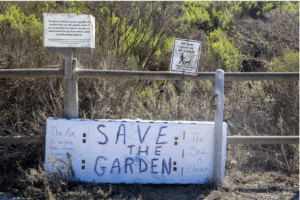
Editor’s Note: This story was first published in the our sister publication, the Tribuno del Pueblo. Part of the mission of both the Tribuno del Pueblo and People’s Tribune is to help protect Mother Earth. Therefore, we focus on informing and collaboratively seeking solutions to jointly address injustices affecting our planet within our communities.
After two weeks marked by stress, sadness, and advocacy from both internal and external community members, as well as numerous individuals’ voices and efforts, the community garden will not be closing. This was the clear message conveyed by Paloma Aguirre to many members of the South Community during the first Town Hall, hosted by Supervisor Aguirre on Tuesday, October 7th, at the San Ysidro Library.
While the garden is currently safe, the community must organize and find a management team to oversee the land. Gardeners need unity for effective management. Supervisor Aguirre will attend the October 18 meeting to discuss how SD County and the community can collaborate to preserve the garden.
SAN DIEGO, CA — The largest community garden in South San Diego, known as the Tijuana River Valley Community Garden, faced significant discouragement and challenges in recent weeks due to rumors of a potential closure, propagated by the organization that has managed this land since its inception in 2002 and caused by the Tijuana River crisis. The potential closure represents a transboundary problem that has persisted for decades, characterized by severe pollution from untreated sewage, industrial wastewater, and debris originating in Tijuana, Mexico, that now affects San Diego in the U.S. For more information on the Tijuana River Crisis, visit the San Diego Coastkeeper website.
The Resource Conservation District of Greater San Diego County (RCD) is responsible for managing a public land that includes 210 plots of 30×30 feet each and 10 incubator small farms dedicated to supporting small businesses. On September 26th, members of the Tijuana River Valley Community Garden received unfortunate news that the conservation district board plans to end its lease with the county due to liability concerns arising from the Tijuana River Crisis.
While these are important measures to consider, instead of closing the garden the conservation district board members should revisit their mission and explore solutions to protect, conserve, and restore these natural resources through education, information, and technical assistance programs, as outlined on their website and as part of their mission.
Many members of the garden and broader community have contacted the conservation district, saying:
“Closing the Garden isn’t the right solution.
Let’s explore better options together.”
San Diego County Supervisor Paloma Aguirre took two actions: a press conference about the Tijuana River Crisis and installing a warning sign about high hydrogen sulfide levels at the garden’s entrance. While these inform the community, they should not justify shutting down the garden. These actions raise concerns among residents because halting public land management, canceling the lease with the county, and closing over 210 garden plots and 10 incubator farms will only worsen the South Bay’s climate.
The community garden’s strength and external support helped unite members and the broader community in the wake of bad news. They expressed concern and sought help from organizations, including Supervisor Aguirre, through phone calls, emails, meetings, social media, and news outlets. Their efforts reached Supervisor Aguirre in District 1, who responded with an Instagram video, offering hope to the community:
The conservation district board members made this rapid decision by informing only small farm businesses by word of mouth, letting them know they would have two months’ advance notice, thereby affording them a limited time to evacuate all their possessions. Additionally, small plot owners will only be granted thirty 30 days to comply. All this information was conveyed verbally, without any formal letter, email, or other official communication.
On October 1st, all gardens received an email to formalize and inform the gardeners of the following:
On July 22, 2025, the County of San Diego Board of Supervisors renewed its proclamation of a local emergency due to the ongoing Tijuana River sewage crisis. With the health and safety of gardeners, farmers, and staff as our top priority—and given the increased flooding and related challenges in recent years—the RCDGSDC has made the very difficult decision to conclude management of the Garden and return the site to the County.
Gardeners will receive a formal 60-day notice to terminate their tenancy by certified mail in the coming days (this language is also copied below).
Many gardeners know about the Tijuana River Crisis, recognizing it’s a broader issue involving third parties, not just local authorities. The community reports show improved air quality compared to two years ago, and no one has fallen ill from garden produce or air pollution. The green space offers health benefits, especially for seniors, supporting mobility, stress relief, and mental health. Limited outdoor activity can harm health, but engaging in green spaces boosts community well-being.
This valuable green space acts as one of the primary ecological lungs for the southern community, supporting residents and attracting migratory birds, bees, butterflies, and other vital species that enhance environmental diversity. These species play a crucial role in environmental conservation and maintaining cleanliness. Native plants, fruit trees, and indigenous flora help address issues like air pollution and other environmental challenges. Many community members have voiced their concerns, highlighting the importance of advocacy and land management, as seen in Supervisor Aguirre’s efforts. A long-term strategy is needed to develop additional green spaces and plant more trees over the next 20 years, aiming to preserve, serve, and restore the land.
Closing the plots and asking gardeners to remove their plants isn’t a solution; it’s harmful. Let’s find a better way that respects effort and keeps our garden vibrant.
Support the Tijuana River Valley Community Garden by signing the petition, sharing their Instagram and YouTube, and visiting the garden. Your support helps find solutions and creates change.