


Editor’s Note; This story was originally published in the LAPublicPress.org here.
LA County residents are being blindsided by proposals that may drain massive amounts of electricity and water. In Monterey Park, a single facility would use more power than the entire city.
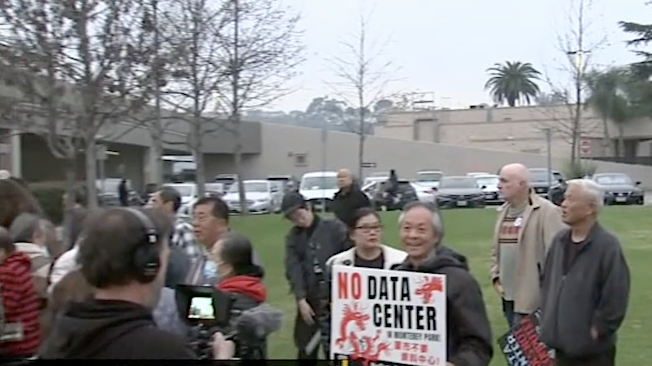
Kana Lee showed up Saturday morning to Barnes Park in Monterey Park with her partner and two small children to learn more about plans for a sprawling data center that would almost double the energy usage of the city’s 20,737 households.
Lee said she was “impressed” to see more than 100 residents from a community that isn’t very politically active turn out to express concerns about the project. “It warms my heart to see my neighbors,” she said.
Lee lives less than a mile away from where the proposed project will be. She said she’s concerned about the data center’s massive use of energy making climate change worse and the effects it could have on people’s physical and mental health, especially as she’s raising a three and five year old in the area.
She also questioned why the city and applicant did not share widespread information about a project of this magnitude. The project has been in the works for more than a year, but she said she only learned about it last month.
“Did they just think that nobody would pay attention?” Lee asked.
The community meeting was hosted by San Gabriel Valley Progressive Action, a grassroots collective advocating for racial justice. It was organized independently of the city and applicant.
The San Gabriel Valley is quietly emerging as LA County’s next data center hotspot. Monterey Park is the latest example of how local communities here are being blindsided by proposals that drain massive amounts of electricity and water. Many Monterey Park residents said they only found out about the proposal because organizers are taking the lead in informing the community.
In city documents, the project applicant is listed as SDCF Monterey Park, LLC, but no companies with that name are registered as businesses with the California Secretary of State.
The applicant is proposing to demolish vacant commercial buildings at 1977 Saturn St. and replace them with a 218,400 square foot single story data center that would sit on 15.8 acres, housing computer servers and equipment for “private clients.” However, specific clients are not mentioned in official documents.
Bryan Marsh, who is listed as the chief executive of SDCF Monterey Park, LLC, and James Pugh, another representative for the project applicant and a partner at Sheppard Mullin, did not respond to requests for comment by the time of the story’s publication. Marsh is also the head of data center real estate at StratCap, an “alternative investment management platform” owned by HMC Capital, an Australian company.
The project is part of the city’s larger plan to revitalize Saturn Park, also known as McCasline Business Park, which has seen a “decline in occupancy and utility” since the rise of remote work post-pandemic, according to the city’s website. The site is surrounded by a park, a commercial nursery, water towers, and residences — with the nearest home less than 500 feet away.
Community advocates hosted the teach-in on Jan. 10 after the Monterey Park City Council postponed a vote on the project on Dec. 3, which would have approved the site’s development plan and adopted what’s known as a mitigated negative declaration, which is a statement that the project won’t cause significant harm to the environment because changes were made to reduce potential impacts. However, local residents do not agree that this step is enough to prevent harm. They’re asking the city to conduct a full environmental impact report.
A new vote was set for Jan. 21 to give the applicant more time to address concerns, but that date was later postponed; a new date has not been set.
Monterey Park residents and allies packed the city council chambers on Dec. 3, filling nearly every seat in the audience and forcing people to stand on the sidelines and hallways. Over two hundred people emailed public comments opposing the project and many more had signed up to speak at the council meeting.
“It’s apparent that the applicant should take some time for community outreach and address a lot of community’s concerns,” Mayor Elizabeth Yang said at the Dec. 3. City Council meeting.
Marsh spoke at the meeting and acknowledged residents’ concerns around the data center and stated the applicant wanted to engage with the public as much as possible.
“We do feel like there’s been a lot of misinformation out there so we’d like to set the record straight,” Marsh said. He vowed to host public meetings to address resident concerns, but no meetings have been scheduled yet, according to residents.
Monterey Park mayor Yang said at the meeting that the decision to postpone the vote was also made to give time to the state’s Fair Political Practices Commission (FPPC) to respond to the city’s inquiry about council member Thomas Wong’s possible conflict of interest in the project. Wong works at Southern California Edison, which will be responsible for providing electrical services to the project, and he has been a key decision maker in the project so far.
In an email to LA Public Press on Thursday, Monterey Park assistant city manager Diana Garcia, said that information about the pending data center project can be found on the city’s website, including the city’s inquiry to the FPPC about council member Wong. Garcia confirmed that the project applicant also has yet to schedule a community meeting.
“As the applicant has not withdrawn its application, and it has not yet been considered by the City Council, the City cannot comment further on the project,” Garcia said, and directed LA Public Press to the applicant for additional information.
Mayor Yang did not respond to a request for comment.
Massive energy use could exacerbate existing power grid issues
Residents have expressed many concerns about living next to a data center — but a big one is the massive projected energy use. At its peak, the center is expected to use 49.9 megawatts — enough to power about 40,000 households, according to Shaolei Ren, an associate professor at UC Riverside.
Ren said the proposed data center is considered “medium sized.” An average operating data center is 45 megawatts, according to an article by the Washington Post. The article highlights that “supersized” data centers are popping up across the U.S. It also projects that data centers will consume more than 10% of the nation’s power usage by 2030.
Barbara, a Monterey Park resident who declined to give her last name to LA Public Press, citing privacy concerns, said she’s concerned the data center will exacerbate recurring blackouts in the neighborhood. She said she already has to tape her fridge shut when there’s blackouts to remind herself not to open it and not spoil her food.
“They want to build a data center when they can’t handle the current load,” she said.
She’d rather see community investments that benefit residents — not make their life harder. “I want houses, I want parks, I want green spaces instead,” she said. “There’s so much opportunity to make our town amazing.”
Residents also worry about the environment and public health. Data centers run continuously and need on-site generators in case of blackouts.
The proposed Monterey Park data center would have 14 stationary diesel-fueled internal combustion engines and generators built on-site. According to Ren, generators release a “large amount of tiny air pollutants,” such as nitrogen oxides, which can cause respiratory health complications, including asthma.
In the city’s initial study of the project, the consultants who prepared the document wrote that the generators would only be used “upon loss of grid power,” but Ren said they need to be maintained regularly and turned on to ensure they’re working. The 14 generators are estimated to use nearly 200 thousand gallons of diesel per year due to testing and maintenance, according to the study.
The project is expected to use zero water on site and instead use a “closed loop cooling system” to keep the servers cool, according to city documents. However, that means that the cooling system, in addition to the client servers, will be “major sources of energy demand for Project operations.”
Local residents said they didn’t know about the proposed data center
Randye, who requested her last name not be used in fear of retaliation, lives in Alhambra on the border of Monterey Park. She said she talked with three neighbors and none of them knew about the project. She’s concerned about the lack of information provided in languages other than English in a community that, according to census data, is 64.7% Asian and 26.7% Hispanic.
“There hasn’t been widespread information given out in the community,” she said. “It needs to be given out in a manner in which it is understood.”
Farrah Su, a spokesperson for the City of Alhambra, said the city had no comment on their resident’s concerns about how the neighboring data center may affect them.
But unions like Ironworkers Local 433, which represents construction workers, are supporting the project because it will bring “significant economic and workforce benefits” to the city.
“The data center represents a substantial capital investment that will generate high-quality construction jobs, expand pathways for state-certified apprentices, and contribute to the region’s long-term economic stability,” Keith Harkey, a business manager for Ironworkers Local 433, wrote in a Dec. 3 letter to the city.
Although data centers can bring jobs during the construction phase, very few of them are permanent, according to an April report by NPR. OpenAI’s Texas-based data center that opened last year took 1,500 workers to build, but only created about a hundred full-time jobs, according to the Wall Street Journal.
UC Riverside professor Shaolei Ren said we “need” data centers as our lives become more digitized. “Internet data doesn’t live in the cloud,” Ren said. “They live in a physical data center space.”
He said data centers will be less of a problem if owners and operators find ways to make them more sustainable and less harmful for neighbors — and that will take public input “and a lot of other considerations.”

Ashley Orona is a journalist and community organizer from South Central Los Angeles. She loves spending time with her family, supporting local businesses, and finding new scenic views around LA.

