


Now that the athletes have returned home following the decadent Italian version of Winter Olympics, we can focus on the “event” getting little attention, hoop jumping. While FBI Director Kash Patel chugged his last locker room beer, and the tyrant-wannabe tarnished the US Men’s hockey team, notices were hitting mailboxes of families lined up for their events — poverty survival.
Hurdles and hoop jumping
A dedicated and determined mother I’ve known for more than 20 years, Melissa N, recently messaged me about her latest events — red tape hurdles to keep her family’s SNAP benefits.
As promised with passage of HR1, the bill we call The Big, Bad, Ugly Bill, our government is cracking down on those considered “unqualified” to use tax dollars to help feed their families. Qualifying for the SNAP (Supplemental Nutrition Assistance Program) “event” used to be pretty rigorous to avoid letting food slip into households of those deemed unworthy. How to make it harder has provided a challenge for White House minions wanting to gain approval of the felon-in-chief. They get a prize!
I’ll let Melissa, the sole caregiver for her son who is autistic and the main caregiver for her grandkids, describe the process (with her permission to share):
“Systemic barriers all created to force those most vulnerable and in need further into poverty and labeled as “uncooperative” thereby ensuring temporary sanctions or permanent disqualification if they cant “figure it out.’ We have to have access to a computer, internet, and transportation in order to meet even the first set of requirements with Workforce. I’ll be hoop jumping if I choose to remain accountable to every whim and new barrier of our current regime of hypocrites and haters.” — Melissa N. 2/23/26
Nose counting
Almost every morning I peruse news articles about family homelessness. This story caught my eye. Since it’s about Cumberland County in my now-home state of North Carolina, I gave it a look. Glad I did!
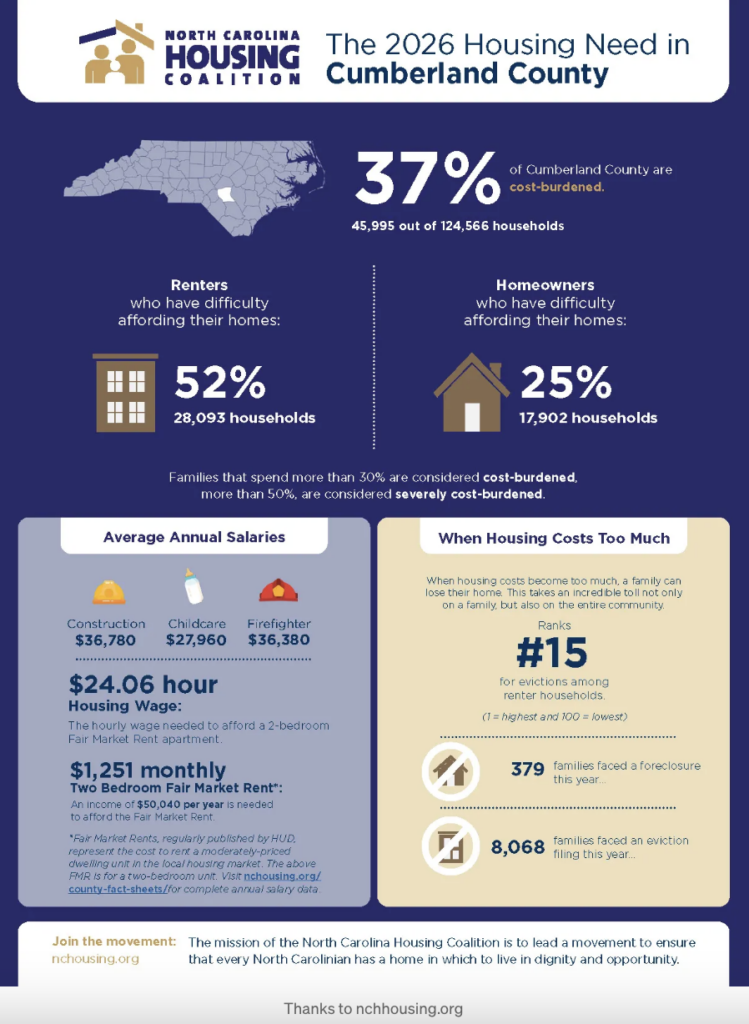
The article highlighted chronic absenteeism, which hovers around 33%. For me, that’s a red flag about the issue I work on — family and student homelessness.
Cumberland County, the fifth largest county in NC, is home to Fayetteville, a city of 300,000 or so, with a racial makeup of Black 42%, white 38%, Hispanic/Latino 13%, and assorted races comprising the balance.
I don’t know much about this city, nor am I a data geek, but I did look into some revealing data that likely speaks to the chronic attendance issue. As someone who’s worked closely with the issue of students experiencing homelessness, I turn to a very helpful website that lets me drill down all the way to school districts and their student homelessness data.
Stick with me…
For Cumberland County, I picked up a dead giveaway. They identified 846 students as homeless for the ’22–23 school year. Their poverty rate for kids 5 -17, just shy of 22%. With a reported 51,512 public school students, about 11,332 students fall into the poverty rate (an underestimated rate by some standards). Those of us familiar with student homelessness issues will estimate 10% of students in poverty could be homeless. Something in the 1,100 range. If you want to check homeless student stats for your district, state, or congressional district, here’s the website.
Press enter or click to view image in full size

Not to pick on Cumberland County
This school district just happened to be the subject of the article about chronic absenteeism. Every time I look at the website with these stats, I typically see similar, or worse, gaps.
For me, it’s not about numbers. It’s about the kids. And families. When kids aren’t identified as homeless, they miss out on invaluable support from the school. They go through anguish because of their circumstances. They’re hungry, tired, and feeling alone. And their childhood homelessness can often lead to adult homelessness.
School districts are required to deal with student homelessness by assigning a homeless liaison, the point person responsible to:
- train district staff,
- ensure students experiencing homelessness are promptly enrolled and assisted to succeed in school, and
- get word out in the community about the “McKinney-Vento” program designed to remove educational barriers for homeless students.
Too often, when liaisons get appointed, the duty gets piled onto too many others, they don’t get trained, nor do they have adequate resources to do their job. Help is on the way!
A new power tool is available!
Proper training is vital! Which is why I wrote the new e-book, Making Bad a Little Better: The least we can do to ease family homelessness. The theory is liaisons get trained. Well, maybe eventually, but from what I hear, they often get thrown into the fire and have to do the best they can without knowing anything much (although NC has a strong state homeless ed program).
My new book! Design by Diane Nilan

Having spent lots of time with good liaisons, and having heard from those who knew they didn’t know what they were doing, I created this e-book as a quick study tool for liaisons and anyone else needing or wanting to know about family homelessness and students’ rights to education.
Some Help is Needed!
My one-woman nonprofit, HEAR US Inc., will market the book, but I’ll admit we can use some help! I’m in the final throes of getting the book online, so I’d suggest you keep an eye on our website, www.hearus.us, for the e-book release info. It’s affordable — $5.99 — so it can get into as many hands as possible. My sister read it and said it needs to be a print book, too. I’ll work on that next.
I created this e-book as a quick study tool for liaisons and anyone else needing or wanting to know about family homelessness and students’ rights to education.
It’s daunting to see the cruelty incorporated in the Big, Bad, Ugly bill. Not every parent will be capable of jumping through the hoops and enduring the grueling process of protecting their families’ essential assistance. No referees are ensuring a fair “contest.” And alleged cheaters will be exiled, unlike those in power who seem to relish every opportunity to exploit and deceive.
For more wisdom and painful observations, The Three Melissas — The Practical Survival Guide to Family Homelessness, is a guaranteed eye-opener. The three Melissas get the proceeds from sales of their book.
For more stories on poverty, public benefits, student homelessness, education equity, and the policies that shape families’ daily survival, follow Fourth Wave. Have you got a story or poem that focuses on women or other targeted groups? Submit to the Wave!
Diane Nilan is President of HEAR US Inc.,an organization that gives voice to families and youth experiencing homelessness. Nilan has devoted her life to advocating for and presenting the real face of homelessness in America, focussing on families and children. She has more than three decades of experience running shelters; advocating for improved state and federal policies; filming/producing award-winning documentaries. Her latest work is the book, Dismazed and Driven: My Look at Family Homelessness in America and The Three Melissas.

