


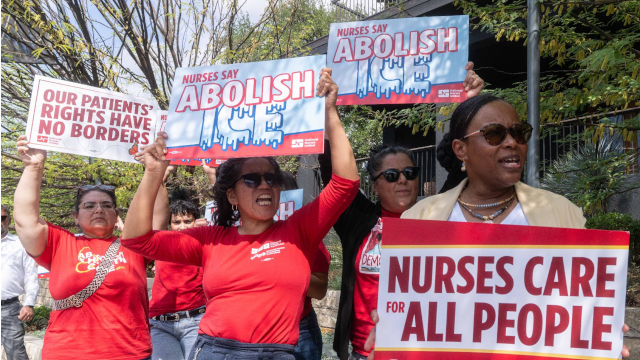
Support and rights advocacy are seen as a duty of care for many nurses who are organizing to protect their patients.
Editor’s note: This article originally appeared in Truthout here.
After the House of Representatives passed bills to send $10 billion in funding to the Department of Homeland Security in January, the nation’s largest union of registered nurses published a demand that Congress abolish Immigration and Customs Enforcement (ICE).
“Nurses demand the removal of immigration enforcement agents from communities, the abolition of ICE, and accountability for this administration’s crimes against all residents of the United States,” read the January 23 statement from National Nurses United (NNU), which represents over 225,000 registered nurses nationwide.
The union’s January 23 statement echoed a call already being made and carried into practice by rank-and-file registered nurses, nursing assistants, and support staff in health care facilities nationwide. Since the Trump administration’s immigration crackdown ramped up, nurses’ unions have written open letters to leadership and organized demonstrations to demand that workplace policies be improved to protect the rights of patients in immigration detention. Those rights include freedom from being shackled or bound, the right to communicate with loved ones, the right to have visitors in their hospital rooms during visiting hours, and the right to have private medical conversations with their care teams. Strengthening policies also helps protect workers from liability if federal agents violate those rights.
“The nurses are the ones that oversee the patient care,” Shiori Konda, a registered nurse who works at a hospital in Minneapolis, Minnesota, told Truthout. “We’re there 24/7, and we have to be the person protecting the patient’s rights.”
The Twin Cities were the site of the Trump administration’s so-called “Operation Metro Surge,” a federal assault that left Minneapolis residents Alex Pretti and Renee Nicole Good dead at the hands of immigration agents last winter. During the onslaught, struggles ensued in local hospitals as federal agents violated patient rights and intimidated health care workers.
“We all know from working here [and] from different accounts that ICE agents are not going to act, many times, lawfully,” Konda told Truthout. “[And] workers of color and the immigrant nurses, they are scared. Some of them are scared to come to work because we have seen ICE detaining people right outside the hospital.”
Because of their frontline role in patient care, nurses have unique opportunities to support patients and advocate for their rights. “We nurses are forever patient advocates and that means we will fight to protect you at the bedside and we will fight to protect you in the streets — just as Alex [Pretti] was doing when he was executed in cold blood by border patrol,” said Mary Turner, NNU president and an intensive care unit registered nurse in the Twin Cities, in a statement issued after Pretti’s killing.
Nurse-led organizing efforts to counter the Trump administration’s immigration crackdown gained renewed purpose when federal agents killed Pretti, a nurse who worked in the intensive care unit at a Veterans Affairs medical center in Minneapolis. Customs and Border Protection agents shot Pretti in the street mere hours after NNU’s call to abolish ICE was issued. Following Pretti’s killing, NNU also mobilized to hold a week of candlelight vigils to honor him and demand an end to ICE funding.
Cliff Willmeng, an emergency room nurse in Minneapolis, emphasized to Truthout that nurses support patients not only as a matter of personal ethics but because “Most nursing practice acts across the country mandate that we advocate for our patients.”
When federal agents disregard the law in health care settings or patients present with signs of abuse or neglect that nurses suspect were perpetrated by agents, as was reported in some high-profile cases during Metro Surge, they are put in “an impossible position,” Willmeng told Truthout. “This changes a nurse’s role from a care provider to, in the worst cases, something like an accomplice. You can imagine the moral injury that takes place in those circumstances.”
Feeling called to fight back, both Konda and Willmeng joined organizing efforts that helped see the Twin Cities through the winter onslaught. Those efforts sprang from but soon outgrew union structures, including relationships Willmeng and Konda had fostered as past leaders in the Minnesota Nurses Association, an NNU local. Working across unions and with immigrant rights groups, Minnesota health care workers conducted “know your rights” trainings, launched campaigns to strengthen hospital policies, and established new workplace communication and rapid-response networks.
When the efforts of rank-and-file workers hit stumbling blocks with management, Willmeng said nurses leveraged their responsibilities to their patients: “We know that federal judges across the country are saying that people are being detained for no legal reasons, people are being detained in retaliation for acting with their First Amendment rights, and then we also know of the conditions of the detention facilities,” he told Truthout. “This isn’t just a matter of nurses’ subjective fears and their feelings. These are considerations that any clinician would have to account for.”
Now initiatives launched in the Twin Cities are inspiring health care workers in other locales. “We started putting the pieces together when things started ramping up in Minneapolis; kind of taking the page out of their book,” Jackson, a nursing assistant and union organizer who works at a hospital in New England and is using a pseudonym to protect himself and his colleagues from retaliation, told Truthout.
“If ICE shows up at the hospital to take a patient or an employee, we are the ones with access to actually be able to stop them.”
Anticipating an escalation in Donald Trump’s immigration crackdown in their area, workers at Jackson’s hospital, including unionized nursing staff, have been preparing for months. They began by advocating for hospital policies that help protect patients and workers from federal agents, learning about patients’ and workers’ rights in encounters with agents, and establishing a rapid-response network specific to local hospitals.
That hospital-based rapid response network interfaces with a regional network led by an immigrant rights group. “The idea was to build a rapid response team that is specific for the hospital, as well as use it as a way to help recruit for the other organization [that’s leading regional rapid response],” Jackson told Truthout.
If a hospital worker spots immigration agents on site, the worker reports it to the regional network. The hospital-specific network pulls relevant sightings from the larger network and issues an additional alert via the peer-to-peer messaging platform Hustle. Using Hustle ensures alerts reach everyone across the hospital-wide network and prevents them from getting buried in a group chat.
Because neighborhood watch networks and whistle patrols cannot operate in health care facilities, a hospital-specific network fills a gap. “If ICE shows up at the hospital to take a patient or an employee, we are the ones with access to actually be able to stop them,” Jackson explained to Truthout. “The response network means there are bodies to back up the hospital policies that are in place.”
Concerned that they could see street attacks like those that rocked the Twin Cities this winter, Jackson and his colleagues are preparing to offer first-aid and street medic trainings to members of their hospital-wide rapid-response network. They are also printing Red Cards, resources from the Immigrant Legal Resource Center that explain how to exercise basic constitutional rights, to offer to at-risk patients.
Organizers in both Minnesota and New England told Truthout that breaking down siloes has been central to their successes. “We realized that in order to address the crisis, we were going to have to organize outside of our individual work titles and that we were going to have to organize with the essential frontline workers across the hospital together,” Willmeng said.
The same has been true in New England, where nurses, support staff, transport workers, hospital security guards, and other hospital staff have fostered relationships with a shared commitment to protecting their co-workers and communities. “My hope is that we can get everyone ready to do the right thing,” Jackson told Truthout.
Ensuring migrant workers and workers of color are empowered to lead has also bolstered efforts. “This new organizing is the most multiracial organizing I have been a part of in a long time [and] there’s a lot of immigrants in it, coming from all over the world with their own shared histories and struggles,” Willmeng told Truthout. “That diversity adds strength to what we’re doing — it’s game-changing.”
Jackson told Truthout that as demands to abolish ICE and community-based efforts to protect migrants and other vulnerable communities grow, he’s confident that nursing staff will continue to show up on the front lines. “These people care about their patients and want to help them every way they can; this is just an extension of that.”

Marianne Dhenin is an award-winning journalist and historian. Find their portfolio or contact them at mariannedhenin.com.

