

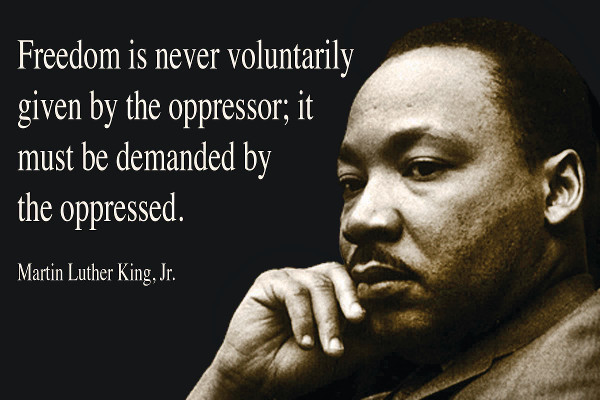
As thousands of articles extolling Martin Luther King Jr., are distributed on his birthday, most will fail to mention the Poor People’ Campaign, the most important crusade of his career and, arguably, the real reason he was assassinated. Mainstream accounts will usually stop with his 1963 “I Have a Dream” speech. Progressives will include his 1967 anti-Vietnam war speech in Riverside Church. But few will mention his assault on poverty, the logical capstone of his life of compassion.
In his last year, King organized the Poor People’s Campaign. He envisioned having low-income families, trained in nonviolence, go to Washington to engage in civil disobedience while demanding an Economic Bill of Rights to end poverty. He had recruited white, Latino, Native American and African American volunteers from across the country. They would demand passage of a $30 billion anti-poverty package that included a commitment to full employment, a guaranteed annual income measure and more low-income housing. It would be the first time leaders of the two most politically powerful minorities—blacks and Chicanos—would unite to confront the government.
This was during the Cold War, when America was competing with the Soviet Union for the loyalty of Africans and Asians so they could have access to their resources. The worldwide exposure of America’s economic underbelly—rampant poverty—would have had major international consequences.
King was shot a month before the Campaign was to begin. The Campaign went on, but no one else had the charismatic power to control it. People flocked to Washington and established a tent city on the Mall, but those trained by King were joined by larger numbers of angry demonstrators, some of whom brought weapons and were not amenable to nonviolent leadership. Demonstrations were held and demands were made, but without King’s eminence, they were only partially heard as the media focused on the disorganization more than on the demands.
The dwindling number of demonstrators lingered on the Mall for weeks until one day, when many of the men were away for a demonstration, an army of more than 1,000 police stormed the Mall, made mass arrests and bulldozed the encampment.
And King’s greatest dream has been virtually bulldozed from history.
Martin Luther King’s Vision
By 
Latest

Free to republish but please credit the People's Tribune. Visit us at www.peoplestribune.org, email peoplestribune@gmail.com
The People’s Tribune brings you articles written by individuals or organizations, along with our own reporting. Bylined articles reflect the views of the authors. Unsigned articles reflect the views of the editorial board. Please credit the source when sharing: ©2024 peoplestribune.org. Please donate to help us keep bringing you voices of the movement. Click here. We’re all volunteer, no paid staff.

