


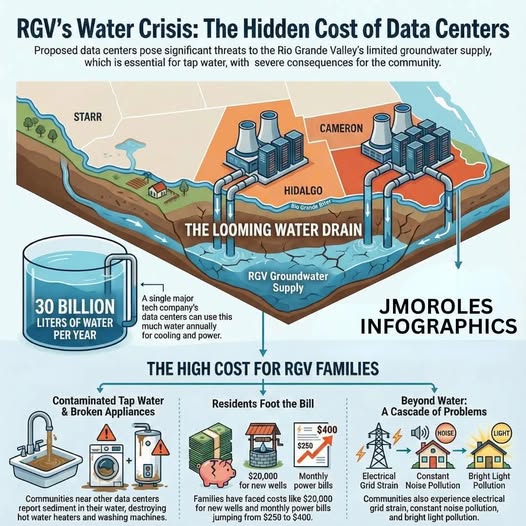
Editor’s Note: This article was written by Joshua Moroles who lives in the Rio Grade Valley (RGV) in far south Texas. Among Joshua’s many interests, data center expansion in Texas is one of them. He uses social media to alert communities in the RGV to proposals for data centers, to educate people about the key issues that data centers bring, and to encourage community members to attend meetings and speak up about their concerns. This article describes the specific issues that the RGV faces when considering data centers. You can find Joshua on Facebook. Above is a graphic from one of his posts.
Did you know the Rio Grande Valley already has data centers? The difference is scale.
Across Texas, a new wave of hyperscale data centers is accelerating—facilities measured not in thousands of square feet, but in square miles. And now, a proposed 2-gigawatt (GW) campus in Cameron County could bring that scale to the Rio Grande Valley.
To understand what’s at stake, we have to start with water.
The Valley depends primarily on the Rio Grande River, which begins in Colorado and travels more than 1,800 miles before reaching us. By the time it flows toward the Gulf, only about 15% of its original volume remains. The rest has already been diverted for cities, farms, and industry upstream. Our secondary waterway, the Arroyo Colorado, is largely sustained by wastewater discharges and does not meet federal water quality standards for recreation or aquatic habitat.
In short: we live at the end of a heavily depleted system.
Meanwhile, Texas as a whole is facing mounting water pressure. Regions like Hays County are in a Stage 4 restriction as groundwater levels approach historic lows. Projections suggest municipal supplies statewide may not meet demand by 2030 without major intervention.
Against that backdrop, consider what a 2 GW data center represents.
The proposed Cameron County campus would span 1,785 acres—about 2.8 square miles—with 16 data halls. At full build-out, a 2 GW facility consumes the equivalent electricity of roughly 1.4 million homes. And because data centers operate 24/7/365, that demand does not drop at night or during emergencies.
Water use is equally significant. Based on industry benchmarks for hot climates, a 2 GW facility could use up to 10.5 billion gallons per year—about 28.8 million gallons per day. That daily amount is comparable to the water use of approximately 96,000 households. Even if reclaimed effluent is used, the water still comes from a shared regional system already under strain.
Cooling design has not been publicly disclosed. Air-based systems, liquid cooling for AI workloads, and hybrid systems all carry different tradeoffs—but none eliminate resource demand. Claims of “zero-water” or “closed-loop” systems require careful scrutiny, especially in extreme heat.
The broader trend is unmistakable. Texas now hosts more than 570 data centers, making it the second-largest market in the U.S. Since 2023, demand has surged sevenfold, driven largely by artificial intelligence. Nationally, more than 5,000 facilities are operating. Growth compounds quickly once infrastructure is in place.
Supporters frame this expansion as an economic opportunity. Critics raise concerns about grid reliability, water security, flooding, and cumulative health impacts. Cameron County has already seen over 300,000 pounds of carcinogens released between 2013 and 2024 as per RGVHealthConnect.org data. The region has experienced five “1-in-100-year” storms since 2018, with some areas of Harlingen now facing a 1-in-5 annual flood risk. This is important because more impervious land is being developed, which will push flood waters into areas that have never flooded before.
Data centers never turn off. When the grid fails, backup generators activate. Their permanence reshapes water planning, energy planning, and infrastructure finance for decades.
This conversation isn’t about being anti-technology. It’s about scale and context. The United States is racing toward artificial general intelligence (AGI), viewing it as a strategic capability tied to economic and national security priorities. That ambition requires enormous compute power—and enormous infrastructure.
The question for the Rio Grande Valley is simple:
Can a region at the end of a river, with a strained grid and mounting climate stress, support infrastructure that never shuts off?
Because once it’s built, there is no off switch.


